 Rizky Amelia
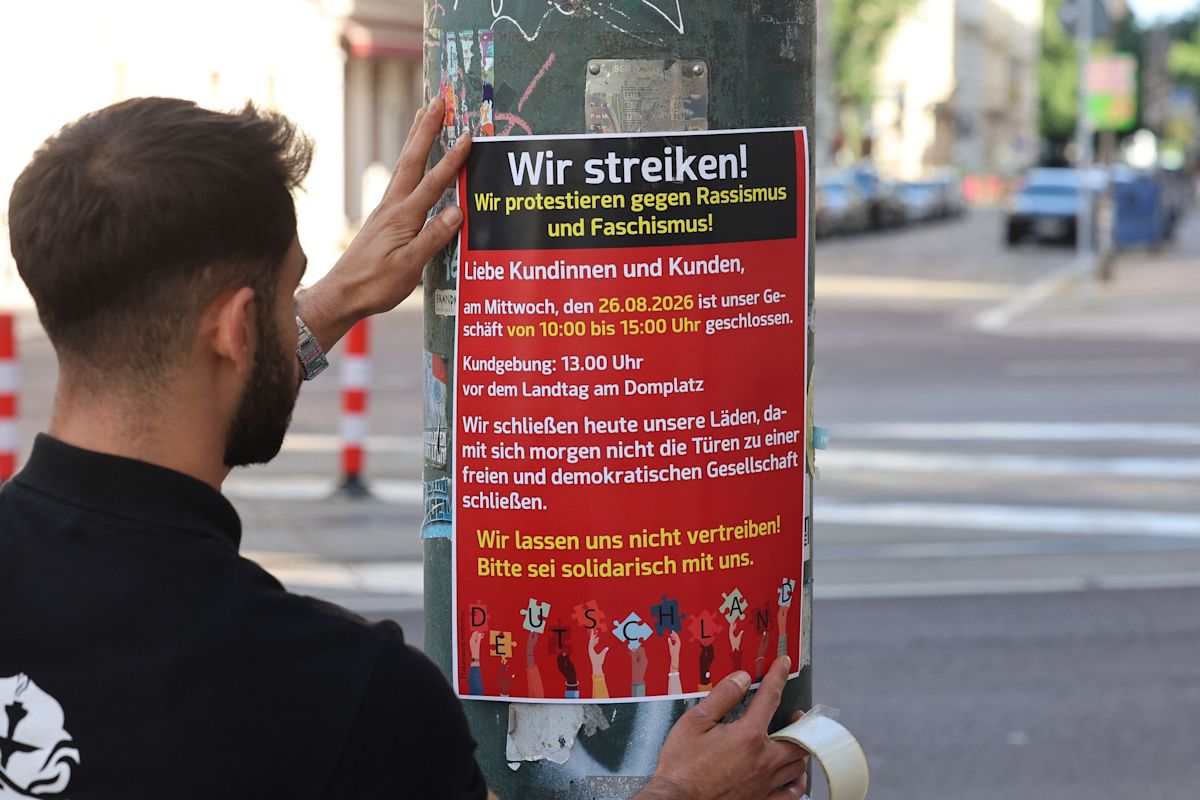
Shops and small enterprises run by people with immigrant backgrounds fell largely silent in the eastern German city of Magdeburg on Wednesday, as owners kept their doors locked for several hours in a coordinated show of opposition to the Alternative for Germany (AfD). The action comes less than two weeks before a state election in Saxony-Anhalt, where the anti-immigrant party currently tops public opinion surveys.
Roughly 150 businesses clustered around Hasselbachplatz, one of the city's central squares, took part in the walkout, according to one of the organizers. The participating venues spanned restaurants, barbershops and kiosks, painting a picture of how deeply rooted migrant entrepreneurship is in the neighborhood's daily life.
The closures ran from 10 am to 3 pm local time (0800 to 1300 GMT). In the run-up to the action, posters calling for the strike had been put up around the district, signaling the breadth of the mobilization well before the morning shutdown began.
Support was not confined to businesses with migrant roots. Several proprietors without any migration background announced plans to join the strike as well, and a rally outside the state parliament was scheduled for later in the day.
Saeeid Saeeid of the Saxony-Anhalt refugee council said the underlying message was about dignity rather than commerce. For him, the central point was that membership in society should never hinge on productivity — that no one should be required to justify their place through labor or economic achievement.
He described an extraordinary mood of togetherness among participants, saying entrepreneurs were motivating one another, pooling their efforts and raising their voices jointly — and peacefully — against racism and exclusion.
Organizers argued that the sight of shuttered storefronts was itself the argument. The strike was intended to make visible everything that would be lost if migrant-run enterprises ceased to exist: they keep care services running, deliver parcels to doorsteps and fill jobs in construction and industry, one co-organizer explained.
At the same time, she stressed that the protest was not merely a demonstration of economic usefulness. Those taking part did not want to be valued only as workers, she said, but recognized as people with the same full range of needs as anyone else. The co-organizer herself works as a social worker in the city.
Above all, she characterized the shutdown as a wake-up call aimed at society at large — an appeal for voters to take a close, hard look at what the AfD's program actually contains before casting their ballots.
The protest lands at a politically charged moment. Saxony-Anhalt elects a new state parliament on September 6, and the AfD's regional branch leads the polls there as it pursues an absolute majority — a result that would allow the party to lead a government in a German state parliament for the first time.
Adding to the tension, Germany's domestic intelligence agency classifies the AfD branch in Saxony-Anhalt as a far-right extremist group, a designation that loomed over a day when the city's kebab joints, salons and kiosks chose silence over business as usual.
-- END --


Comments (0)